Before you hire a Junior Designer, consider this first
When growth begins to change how you spend your time
As studios grow, something very common begins to happen. Projects start overlapping, timelines tighten, and the number of drawings and revisions increases.
At first, it feels like a natural sign of progress. But soon, a large part of your time is no longer spent designing — it is spent producing.
Updating plans.
Adjusting documentation.
Coordinating revisions.
Preparing information for clients, contractors, and suppliers.
All essential work. But very time intensive.
Many studio owners reach the same conclusion at this stage:
“We need to hire.”
Hiring is an important step — but also a long-term commitment
Hiring a junior designer can absolutely be the right decision at the right moment. But it is also a long-term commitment — salary, onboarding, training, and the responsibility to maintain consistent workload throughout the year.
The reality is that project demand rarely stays constant. Some months are very busy, others more balanced. And often, the real pressure is not coming from the creative side of the process, but from the volume of technical production required to move each project forward clearly and accurately.
Increasing capacity without immediately expanding the team
For many studios, a more flexible approach is to increase production capacity without immediately expanding the internal team.
Production support allows you to scale assistance depending on workload:
Busy periods → increase support
Calmer periods → reduce support
This keeps the internal team focused on the areas that create the most value:
Client relationships
Concept development
Material decisions
Spatial solutions
Creative direction
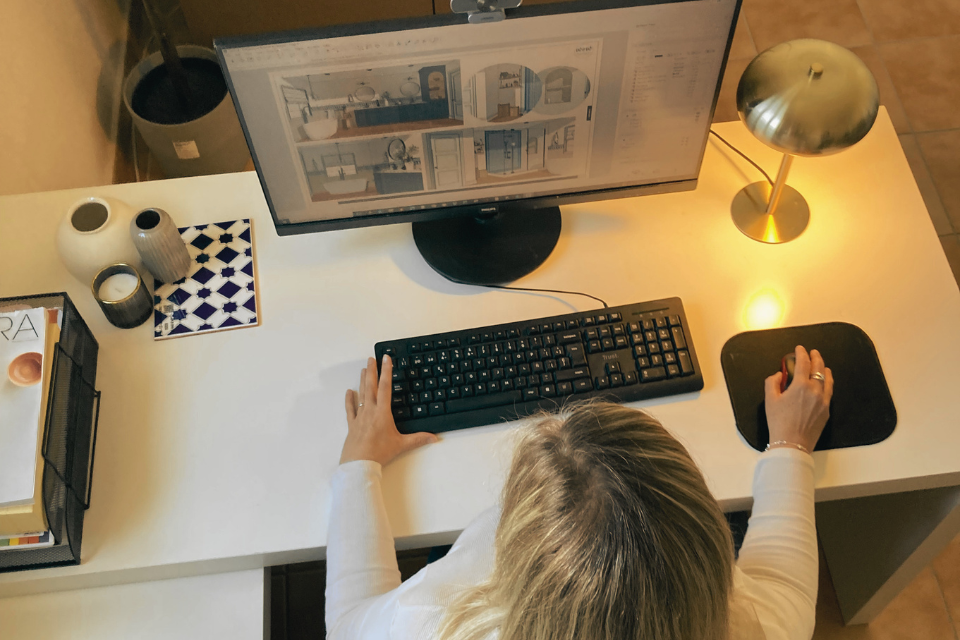
Why separating creative work from production improves workflow
Technical documentation remains essential, but it requires a different type of focus and structure. When creative work and production tasks compete for the same time, projects often feel heavier than they should.
Separating these two areas helps both perform better.
Creative work benefits from space and clarity.
Production work benefits from consistency and process.
In many studios, the real bottleneck is not ideas — it is the time required to translate those ideas into clear, accurate documentation.
Before committing to a permanent hire, it can be worth looking at where additional production capacity could immediately improve workflow, reduce pressure, and allow the design team to stay focused on what they do best.

A practical first step before expanding your internal team
In my own experience, the need at this stage is often not another creative voice, but dependable production capacity that allows projects to move forward smoothly without placing unnecessary pressure on the design team.
Design Support Studio was created to support interior designers specifically at this point in their growth. We work alongside studios providing structured support with 3D modelling, technical drawings, FF&E documentation, and visualisation, helping ensure ideas are translated into clear, professional information for clients, contractors, and suppliers.
For many studios, this type of support becomes a practical first step before expanding the internal team — allowing workflows to stabilise, capacity to increase when needed, and providing greater clarity around when a full-time hire is truly the right decision.
When production flows efficiently, projects move forward with greater consistency, reduced pressure, and more space for the creative work that drives each design forward.